
.png?width=300&name=Stock%20Imagery%20Backgrounds%20(17).png)
Overview
- Long-term Treasury yields have moved to levels not seen in nearly two decades, but the increase appears to be driven more by higher real yields and greater competition for capital than by a major deterioration in long-term inflation expectations.
- Higher yields create a more demanding backdrop for stocks by raising borrowing costs and making bonds more competitive for investor capital. They have also improved the income available from high-quality fixed income.
- We believe the move deserves attention, but the evidence does not currently point to a Treasury or debt crisis. Our tactical portfolios remain modestly overweight equities, while fixed income continues to play an important role in diversification and income.
30-Year Treasury Yields Reach a 19-Year High: What it Means for Portfolios
Long-term interest rates are back in focus. The 30-year Treasury yield recently climbed above 5.3%, a level last seen in 2007, while the 10-year Treasury yield has moved into the upper-4% range. After years in which investors grew accustomed to much lower rates, the move has understandably drawn attention.
Higher yields matter because their effects extend well beyond the bond market. They influence mortgage rates, corporate borrowing costs, government interest expense and ultimately the valuations investors are willing to pay for stocks. They can also create short-term losses in existing bond holdings as prices adjust to the higher-rate environment.
The level matters, but the reason yields are rising matters more.
In our view, the current move looks less like a renewed inflation scare and more like investors demanding greater compensation for holding long-term bonds.
What's Driving Long-Term Rates Higher?
A long-term Treasury yield has two basic components: compensation for inflation (also called “the breakeven rate”) and the return an investor expects to earn above inflation (called “the real yield”).
Inflation compensation has barely moved in four years (orange line in the middle clip below), which tells us investors still expect inflation to behave over the long run. The real yield is what has changed. It has climbed to roughly 2.4% from 1.5% in September 2024 (bottom clip in chart below). Most of the recent upward pressure on yields has therefore come from higher real yields rather than a sharp rise in expected inflation.
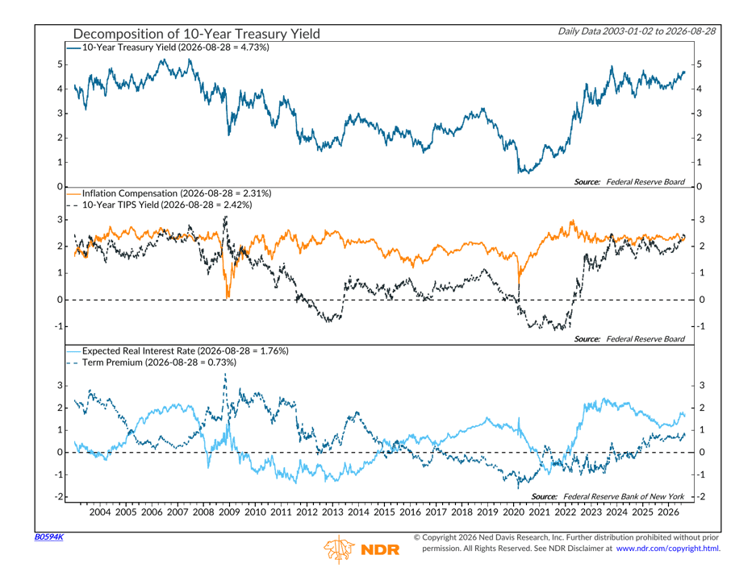
Part of the increase in real yields reflects a higher term premium, the extra return investors demand to lock up money for 10, 20 or 30 years when there is greater uncertainty around inflation, economic growth, government borrowing and future interest rates.
If long-term inflation expectations were moving sharply higher, that would suggest markets were losing confidence in the Federal Reserve’s ability to maintain price stability. So far, the data do not show that. Investors are instead demanding more compensation for the uncertainty that comes with owning longer-term bonds.
Government borrowing is one reason that uncertainty has increased. The federal budget deficit remains elevated, and the government’s financing needs remain substantial. More borrowing means more Treasury securities that need buyers. If demand does not keep pace with supply, bond prices fall and yields rise.
The buildout of artificial intelligence infrastructure is also increasingly being financed through the bond market. Major technology companies are investing heavily in data centers, computing infrastructure and other long-lived assets. That investment may ultimately support stronger productivity and economic growth, but it also adds another large source of demand for capital today.
The federal government and some of the world’s largest companies are now competing for capital at the same time. That gives bond investors more alternatives and puts upward pressure on the yields borrowers have to offer.
What Can the Treasury Do About It?
The Treasury Department has responded to some of the pressure at the long end of the bond market.
Beginning in September, Treasury is at least doubling the size of certain bond buyback operations involving longer-dated securities, from a maximum of $2 billion to at least $4 billion per operation. These buybacks can help improve market liquidity and reduce some of the pressure in areas where long-term bonds have been particularly volatile.
Treasury has some control over how the government finances itself and can take steps to improve market functioning, but it cannot eliminate the borrowing created by the federal deficit.
We view these actions as market-management tools, not a solution to the broader fiscal problem.
Changing the fiscal trajectory ultimately requires slower spending growth, higher revenues, stronger economic growth, or some combination of the three.
Does This Mean the U.S Is Facing a Debt Crisis?
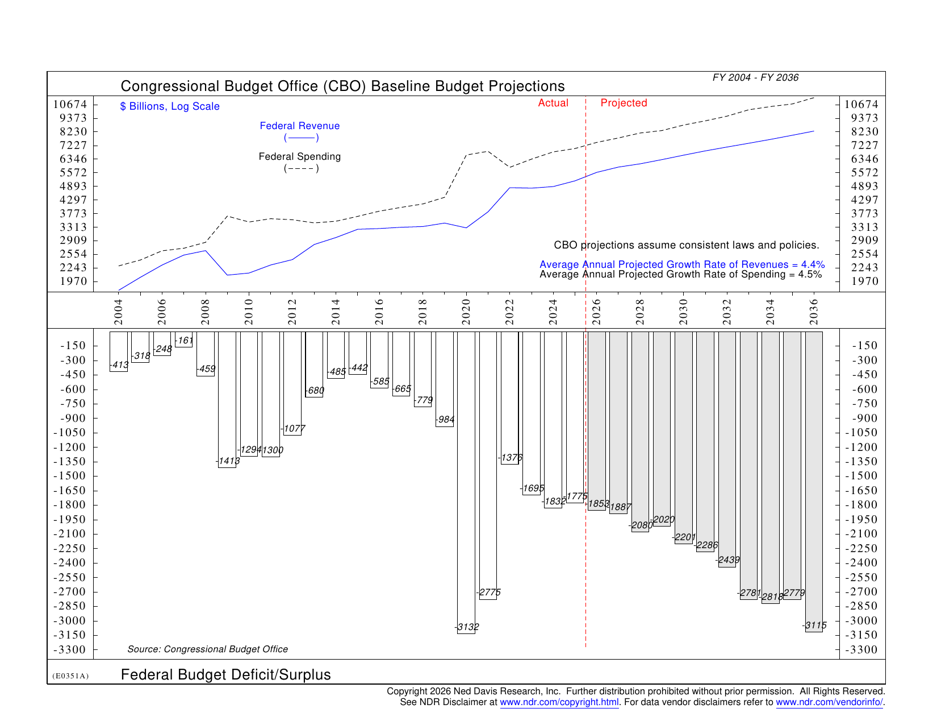
Fiscal concerns are legitimate and should not be dismissed. Government debt is large, deficits remain elevated, and higher interest rates make servicing that debt increasingly expensive. Those pressures are likely to remain part of the investment landscape for years. The Congressional Budget Office projections show deficits widening toward $3 trillion by the mid-2030s and net interest climbing to 4.5% of GDP by 2036 from 3.2% today (chart below).
But describing the current environment as a “debt crisis” goes further than the evidence supports.
A key question is whether the economy can continue growing fast enough to support the government’s borrowing costs. Despite a meaningful slowdown in second-quarter real GDP growth, consumer spending and private-sector investment have remained relatively resilient.
Long-term inflation expectations also remain relatively stable, and the Treasury market continues to function.
The fiscal path is still difficult, but a long-term fiscal challenge is different from an imminent financial crisis. We believe the current evidence points to the former, not the latter.
Why This is Different from 2022
The comparison to 2022 is natural because stocks and bonds both fell as yields surged. The starting point today, however, is different.
In early 2022, the 10-year Treasury yield was around 1.5%, inflation was accelerating rapidly and the Federal Reserve was beginning what would become its most aggressive tightening cycle in decades. Bond investors had very little income to offset falling prices.
Today, the 10-year yield is closer to 4.7%, inflation expectations are much more stable and monetary policy is already restrictive. The debate at the Federal Reserve is now about whether additional tightening is necessary, not about beginning a hiking cycle from interest rates near zero.
| 2022 | 2026 | |
| Starting 10-year yield | Near 1.5% | Near 4.7% |
| Direction of Fed Policy | Fast, Aggressive tightening | Policy on hold, market pricing modest hikes |
| Inflation Trend | Accelerating Sharply | Sticky above target, core PCE 3.3% |
| Inflation Expectations | Rising | Anchored near 2.3% |
| Starting Income from Bonds | Minimal | Highest in roughly two decades |
| S&P 500 calendar-year return | Down about 19% | Up roughly 12% year-to-date |
The higher starting yield gives bond investors more income to offset price declines.
At a 1.5% yield, it did not take much of an increase in rates to overwhelm a year’s worth of bond income. At today’s yield levels, investors are collecting considerably more income while they wait. Longer-term bonds can still decline if yields continue moving higher, but the income cushion is substantially larger than it was entering 2022.
What Higher Yields Mean for Stocks
For stocks, higher yields create two pressures.
-
First, higher rates increase borrowing costs for businesses and consumers.
-
Second, they make bonds more competitive as an alternative source of return. That raises the return hurdle stocks need to clear.
Higher real yields can also put pressure on valuations. When investors can earn a higher inflation-adjusted return from Treasury bonds, they may be less willing to pay as much for a dollar of future corporate earnings.
Rising yields do not automatically mean falling stock prices. If rates are rising alongside resilient growth, improving productivity and strong corporate earnings, equities can absorb some of that pressure.
The more difficult setup would be yields continuing to rise while growth and earnings soften. That combination would tighten financial conditions and leave equity valuations with less room for disappointment.
What We're Watching From Here
The 5% level on the 10-year Treasury is one area we are watching. A brief move above 5% would not, by itself, change our outlook. A sustained move materially above that level would be more meaningful because it could signal tighter financial conditions for housing, business investment and equity valuations.
We are also watching inflation expectations. They remain relatively well anchored around the low-2% range. A sustained move higher would be more concerning because it would suggest investors are beginning to price in structurally higher inflation, rather than simply demanding greater compensation for uncertainty.
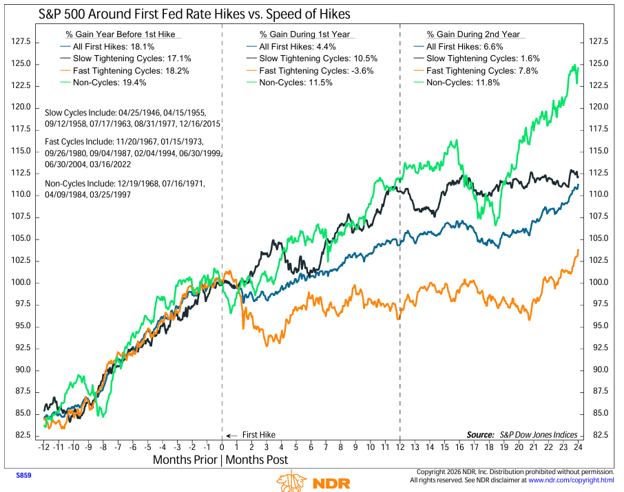
The pace of Fed policy matters too. A slow and measured adjustment in rates is very different from the rapid tightening cycle investors experienced in 2022. The speed of any additional increases may matter more than whether the Fed raises rates once or twice. The chart below shows that during slow rate hike cycles, stocks have gains 10.5% on average a year after the first rate hike.
The final piece is growth and corporate earnings. If the economy remains resilient and earnings continue to advance, equities may be able to absorb higher yields. If higher borrowing costs begin to slow growth while earnings weaken, the balance of risks would become less favorable.
How This Impacts SPW Portfolios
Higher rates have also restored something that was largely missing during the low-rate era: meaningful bond income.
Within fixed income, our models continue to emphasize diversified core bond exposure alongside an actively managed multisector allocation. We prefer this approach to making a concentrated bet on a single maturity or attempting to predict exactly where interest rates will move next.
Our goal is to collect attractive income while maintaining diversification and giving managers flexibility to invest where they believe the compensation is appropriate for the risk taken.
On the equity side, our tactical portfolios remain modestly overweight stocks relative to their benchmarks, funded primarily through an underweight to bonds, while cash remains near neutral. That positioning has not changed.
We still believe the weight of the evidence supports a modest equity overweight, but higher long-term yields leave less room for disappointment. Strong earnings growth becomes more important as rates raise the hurdle for equity valuations.
We will continue to follow the weight of the evidence and adjust portfolio risk as conditions change.
Disclaimer: The information contained in this market commentary reflects the opinions of Stratos Private Wealth. These opinions do not reflect the views of others and are subject to change without notice. Content in this material is intended for general information purposes only and should not be construed as specific investment advice or recommendations for any individual. Please contact your advisor with any questions or for specific recommendations regarding your own circumstances. Investing involves risks including possible loss of principal. Stratos Private Wealth is a division through which Stratos Wealth Partners, Ltd. markets wealth management services. Investment advisory services offered through Stratos Wealth Partners, Ltd., a registered investment adviser. Stratos Wealth Partners and its affiliates do not provide tax, legal, or accounting advice. This material has been prepared for informational purposes only; and is not intended to provide, and should not be relied on for, tax, legal, or accounting advice. You should consult your own tax, legal, and accounting advisors before engaging in any transaction. Content in this material is for general information only and not intended to provide specific advice or recommendations for any individual. To determine which strategies or investments may be suitable for you, consult the appropriate qualified professional prior to making a decision. Investing involves risk including possible loss of principal. Some of the information contained herein has been obtained from third party sources which are reasonably believed to be reliable, but we cannot guarantee its accuracy or completeness. The information should not be regarded as a complete analysis of the subjects discussed
-1.png?width=290&name=Website%20Team%20Photos%20(20)-1.png)