
-1.png?width=300&name=Webinar%20Thumbnail%20Template%20(2)-1.png)
Crisis Headlines and Market Reality: Perspective on the U.S- Iran Conflict
- Geopolitical crises often cause short-term market volatility, but historically markets often recover once uncertainty fades.
- Energy prices and inflation are the key economic channels to watch. particularly if global oil supply is disrupted for an extended period.
- Current market signals remain mixed but constructive, suggesting investors focus on long-term positioning rather than reacting to headlines
Heightened tensions between the United States and Iran have introduced a new layer of uncertainty into financial markets. Whenever geopolitical developments dominate headlines, investors naturally ask whether the situation could derail economic growth or trigger a deeper market correction.
Markets typically respond quickly to geopolitical shocks. Initial declines are common as investors reassess risk and reposition portfolios. However, history suggests that most geopolitical events influence markets primarily through short-term volatility and sentiment, rather than causing lasting damage to the economic cycle. Periods of conflict often coincide with temporary market pullbacks, but the broader historical pattern has been one of recovery once uncertainty subsides. Compared with traditional bear markets, declines tied to geopolitical events have typically been modest and recoveries have historically occurred within weeks or months.
As the chart below illustrates, major geopolitical events have often coincided with temporary market declines followed by recovery once uncertainty fades
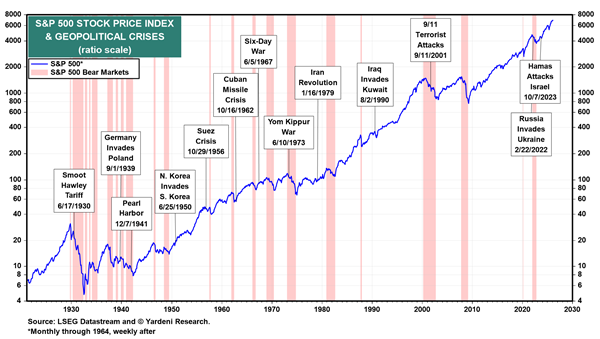
The key distinction is whether a crisis spills over into the economy. When events disrupt global trade, energy supply, or financial stability, such as the oil embargo of the 1970s or financial stress during 2008, market declines tend to be deeper and longer lasting. When economic damage is limited, markets have historically proven more resilient.
At this stage, the most important channel connecting the current conflict to markets is energy prices and inflation.
Oil Markets and the Inflation Question
The Middle East remains central to global energy supply, which means geopolitical tensions often translate quickly into oil price volatility. Higher energy prices can ripple through the economy by raising transportation costs, production expenses, and consumer prices.
For investors, the key question is whether the conflict leads to a sustained disruption in global oil supply, particularly through major shipping routes such as the Strait of Hormuz.
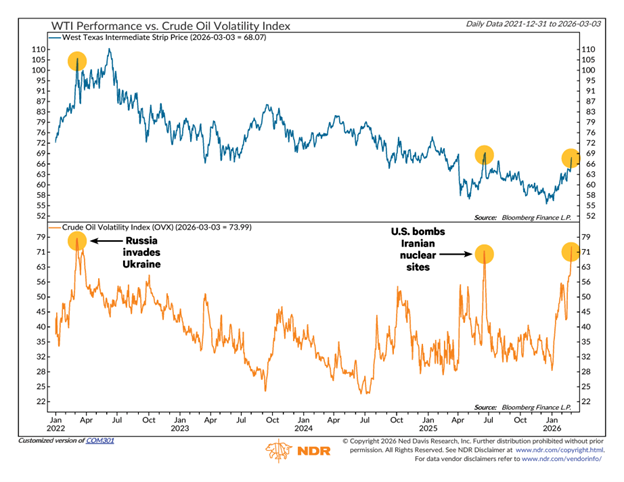
Energy markets initially reacted sharply as tensions escalated, with crude oil prices briefly moving above $110 per barrel for the first time since 2022. In recent sessions, prices have moderated and moved back below that level as markets reassessed the likelihood of sustained supply disruptions.
At present, global oil production remains relatively balanced relative to demand. Unless the conflict materially disrupts production or key shipping routes such as the Strait of Hormuz, energy price increases may prove temporary rather than persistent.
From a broader inflation perspective, the trend over the past two years has been toward moderation. That disinflationary backdrop has been an important driver of the current market expansion.
While a temporary oil spike could slow that progress, inflation indicators would likely need to rise meaningfully before altering the broader economic outlook.
The Federal Reserve Complication
Geopolitical tensions can complicate the Federal Reserve’s policy path, particularly when inflation and growth signals move in different directions.
If energy prices rise significantly, inflation could move higher in the short term. At the same time, geopolitical uncertainty often weighs on business confidence and investment, potentially slowing economic growth.
This type of environment creates a challenge for policymakers. Markets are also adjusting to the early stages of a Federal Reserve leadership transition, with Kevin Warsh expected to succeed Jerome Powell as Chair in May. Historically, changes in Fed leadership have coincided with increased market volatility as investors reassess how the incoming chair may shape monetary policy and the future direction of interest rates.
However, it is important to remember that monetary policy decisions ultimately depend on sustained economic trends, not short-term geopolitical developments. Unless higher energy prices persist long enough to influence inflation expectations more broadly, the conflict alone may not fundamentally change the Fed’s longer-term policy trajectory
What History Suggests About Crisis Events
One of the most consistent lessons from market history is that major headlines rarely align with optimal investment decisions.
When uncertainty peaks, investors often feel the strongest urge to reduce risk. Yet historically, selling during crisis-driven declines has frequently resulted in missed recoveries once conditions stabilize. Ned Davis Research analyzed 59 historical crisis events and subsequent stock performance. As the table below indicates, initial stock weakness has been followed by positive returns in the subsequent year.
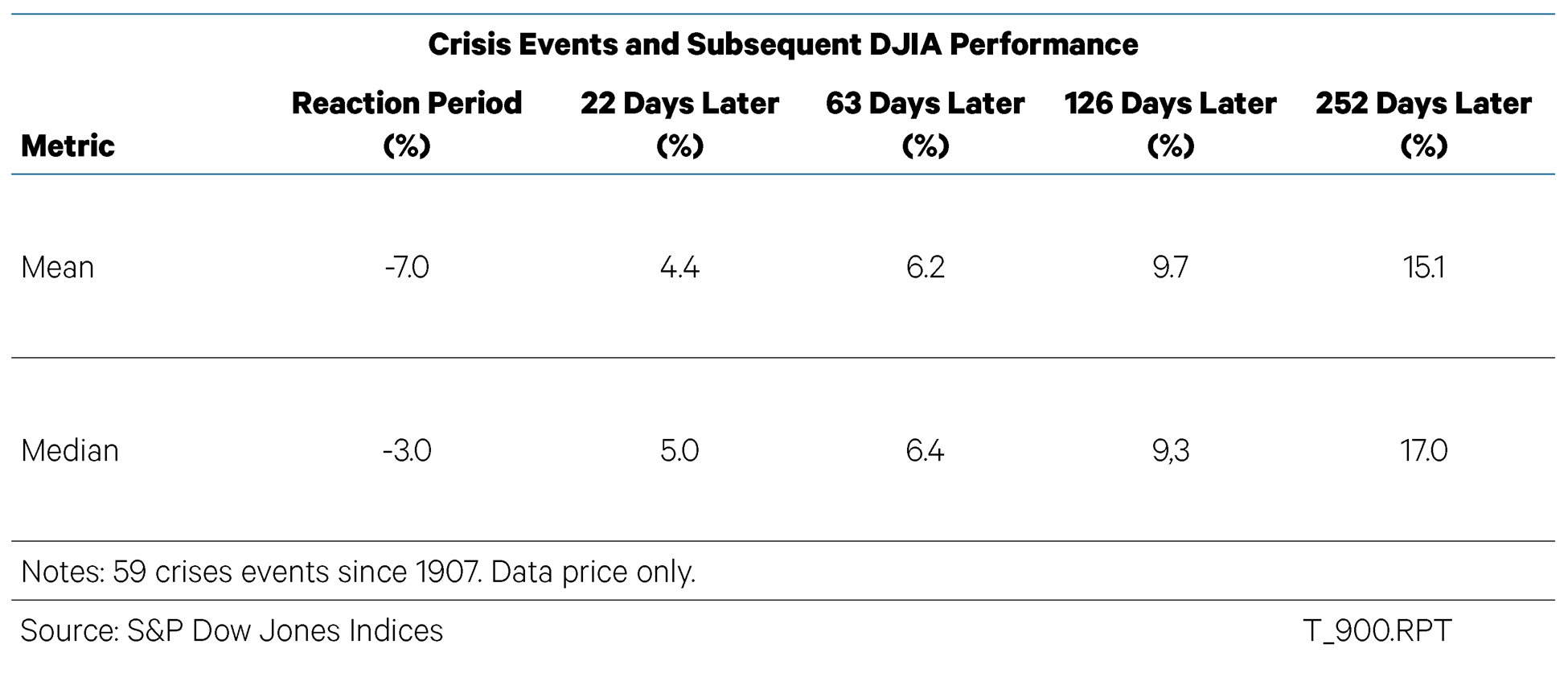
Market reactions to crisis events are often short-lived unless economic conditions deteriorate significantly.
Historical market performance suggests equities have often recovered from crisis-related declines within months, provided the events did not significantly damage the global economy.
This pattern reinforces an important principle: markets often react first to uncertainty and then later refocus on fundamentals such as earnings growth, economic activity, and monetary policy.
The Bottom Line
Geopolitical events understandably attract intense attention from investors and the media alike. Yet history shows that most crisis events have had limited long-term impact on equity markets unless they significantly disrupt economic activity.
The current tensions between the United States and Iran add uncertainty to an environment that already includes inflation concerns, evolving Federal Reserve policy, and ongoing market rotation.
For long-term investors, the most important principle is maintaining perspective. Short-term volatility is a normal part of investing, especially during periods of geopolitical uncertainty.
While risks remain and uncertainty is elevated, historical market behavior suggests that geopolitical events have not always translated into lasting economic or market disruptions. Maintaining diversification and focusing on long-term objectives has historically proven more effective than reacting to short-term headlines.
We will continue monitoring developments closely and adjust our outlook if the underlying economic evidence changes.
Disclaimer: The information contained in this market commentary reflects the opinions of Stratos Private Wealth. These opinions do not reflect the views of others and are subject to change without notice. Content in this material is intended for general information purposes only and should not be construed as specific investment advice or recommendations for any individual. Please contact your advisor with any questions or for specific recommendations regarding your own circumstances. Investing involves risks including possible loss of principal. Stratos Private Wealth is a division through which Stratos Wealth Partners, Ltd. markets wealth management services. Investment advisory services offered through Stratos Wealth Partners, Ltd., a registered investment adviser. Stratos Wealth Partners and its affiliates do not provide tax, legal, or accounting advice. This material has been prepared for informational purposes only; and is not intended to provide, and should not be relied on for, tax, legal, or accounting advice. You should consult your own tax, legal, and accounting advisors before engaging in any transaction. Content in this material is for general information only and not intended to provide specific advice or recommendations for any individual. To determine which strategies or investments may be suitable for you, consult the appropriate qualified professional prior to making a decision. Investing involves risk including possible loss of principal. Some of the information contained herein has been obtained from third party sources which are reasonably believed to be reliable, but we cannot guarantee its accuracy or completeness. The information should not be regarded as a complete analysis of the subjects discussed
-1.png?width=290&name=Website%20Team%20Photos%20(20)-1.png)